Cheap Meal Prep Ideas That Actually Save You Money
By:Author:Koi Yoga Editorial
Updated on:September 30, 2026
- Does Cheap Meal Prep Actually Work?
- Why This Beats the Harder Alternative
- The Quantity Question: How Much Should You Prep?
- The Practical Question: What Do You Actually Prep?
- Comparison: Meal Prep vs Buying Meals Day to Day
- The Forbidden Promise, Answered Honestly
- Levers That Change the Result
- How Long Until You See Results?
- Your First Four Weeks
- What Stalls Progress
- Why Koi Yoga Works for This
- Final Thoughts
A week of home-cooked lunches built from five or six base ingredients almost always costs less than the same five days of takeaway or packaged meals bought one at a time.
The saving comes from buying in bulk, cooking once, and splitting the result into portions instead of paying a markup on every single meal.
This guide covers what actually makes meal prep cheap, how much to cook, what stalls the habit, and how pairing it with short daily movement keeps the whole thing sustainable.
Does Cheap Meal Prep Actually Work?
The mechanism is simple arithmetic, not magic. Buying a 2kg bag of rice, a tray of eggs, and a bulk pack of chicken thighs costs less per gram than buying small packaged portions of the same food.
Split one big batch of cooked food across five containers and the cost per meal drops sharply compared with five separate takeaway orders or five single-serve ready meals.
There is no trick ingredient that makes this work. It is repetition - the same cooking session, the same base ingredients, spread across more meals - that brings the average cost down.
Why This Beats the Harder Alternative
The harder alternative is deciding what to cook from scratch every single night, after work, when energy is lowest and takeaway apps are one tap away.
Meal prep removes that decision point. The food is already made, already portioned, and already cheaper than whatever gets ordered at 7pm out of tiredness.
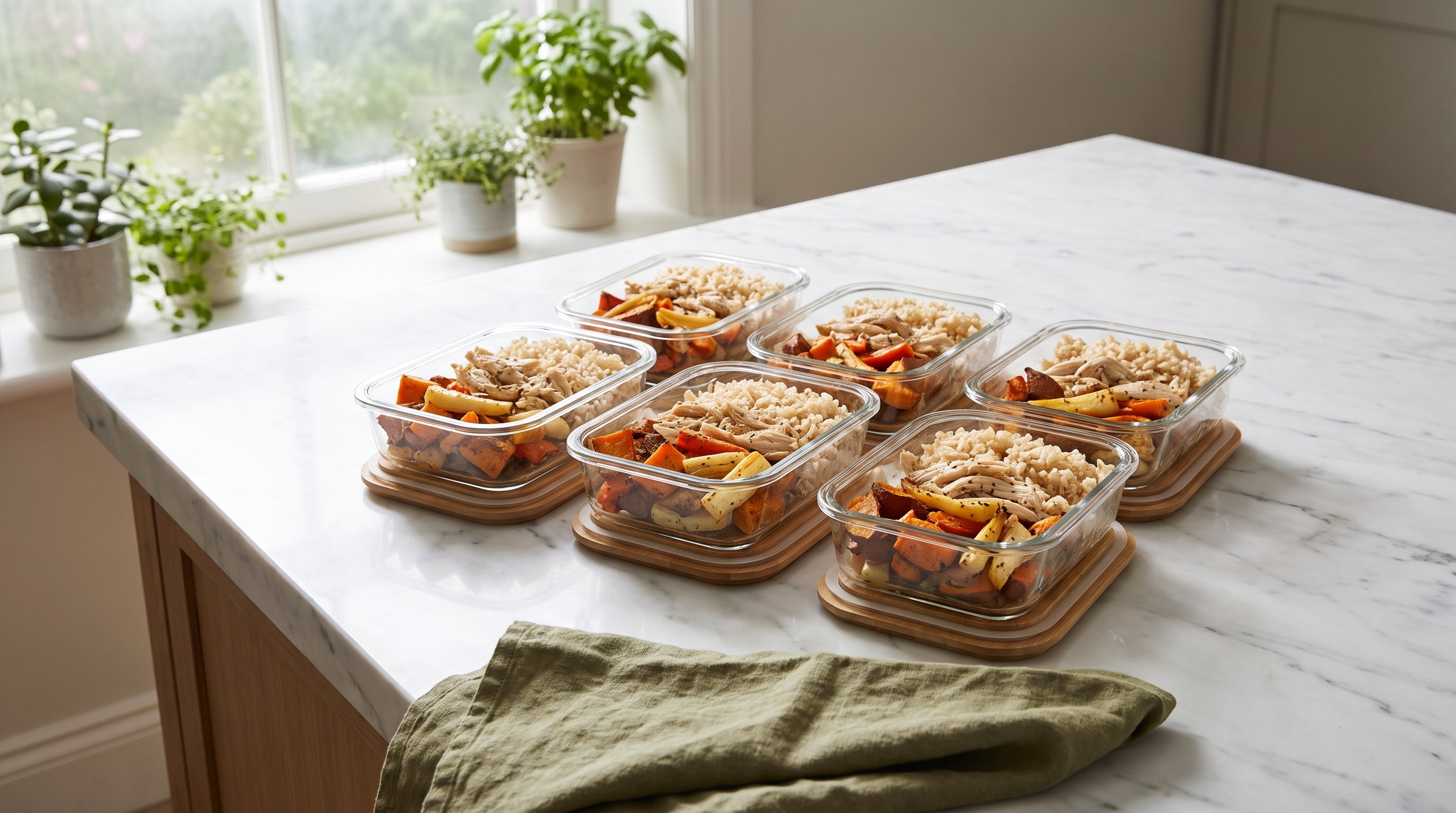
Adherence beats intensity every time. A simple prep routine you actually repeat each week will save more money over a year than an elaborate one you abandon after two.
The Quantity Question: How Much Should You Prep?
Most people start by prepping too much variety and too little volume of any single dish, which is exactly backwards for saving money.
Fewer dishes, bigger batches, more repeats. Three base meals cooked in bulk will almost always cost less than seven different meals cooked in small amounts.
Find Your Own Number
Start with one protein, one grain or starch, and two vegetables you actually enjoy, then scale the batch to however many lunches or dinners you need that week.
| Goal | Batch Size | Cook Sessions |
|---|---|---|
Lunches only | 5 portions | 1 per week |
Lunch and dinner | 10 portions | 1-2 per week |
Family of four | 20 portions | 2 per week |
Solo, low effort | 3-4 portions | 2 per week |
The Practical Question: What Do You Actually Prep?
Cheap staples do most of the heavy lifting: rice, oats, beans, lentils, eggs, frozen vegetables, and whatever protein is on offer that week.
Cook the base in bulk, then vary the sauce, spice mix, or side each day so it does not feel like eating the same meal five times even though the cost stays low.
Keeping track of what you have prepped, what you have eaten, and what still needs using is where a lot of people lose the thread partway through the week.
A meal plan built around food you already like, paired with a simple daily habit tracker, is where Koi Yoga fits into this - it keeps the meals and the small daily movement sessions in one place instead of scattered across notes and reminders.
Comparison: Meal Prep vs Buying Meals Day to Day
The real decision most people are weighing is not which diet to follow. It is whether to spend one to two hours cooking on a Sunday or spend small amounts of money and time every single day instead.
| Factor | Meal Prep | Day To Day |
|---|---|---|
Cost per meal | Lower per portion | Higher per portion |
Time spent daily | Minutes to reheat | Time to shop or order |
Decision fatigue | Made once a week | Made every day |
Food waste | Portioned in advance | Depends on planning |
Flexibility | Less spontaneous | More spontaneous |
The Forbidden Promise, Answered Honestly
No meal, however cheap or well portioned, targets fat loss from one part of the body. That is simply not how the body works, and no amount of clever prepping changes it.
Cheap meal prep does not produce overnight results either. What it does is make it easier to hold a sensible eating pattern for longer, because the food is already there and already affordable.
The honest answer is that consistency, not any single meal or ingredient, is what moves the needle over time.
Levers That Change the Result
Some choices matter more than others for keeping meal prep cheap and sustainable.
Levers That Matter Most
- Batch size - cooking one large portion of a staple almost always costs less per meal than cooking small amounts repeatedly.
- Ingredient repetition - reusing the same base ingredients across several meals keeps the shopping list short and the bill low.
- Portioning habits - splitting food into containers straight after cooking stops it disappearing in one sitting or going to waste.
How Long Until You See Results?
The savings show up fastest, usually within the first couple of shopping trips once bulk staples replace individually packaged meals.
Changes in how you feel day to day - steadier energy, fewer impulse takeaway orders - tend to take longer and vary from person to person.
The people who stick with it longest are usually the ones who kept the routine simple in week one rather than trying to overhaul everything at once.
Your First Four Weeks
The order you build these habits in matters more than getting every detail right straight away.

| Week | Focus |
|---|---|
Week 1 | One batch, one protein, one grain |
Week 2 | Add two cheap vegetables to rotation |
Week 3 | Vary sauces to reduce repetition fatigue |
Week 4 | Scale batch size to match real appetite |
What Stalls Progress
Buying Too Much Variety Too Soon
A long shopping list of different ingredients gets expensive fast. Stick to two or three staples until the routine feels automatic, then expand slowly.
No Containers, No Portioning
Cooked food without a plan for storage tends to get eaten all at once or wasted. A basic set of containers solves this on its own.
Cooking Without a Fixed Time Slot
If prepping depends on finding a spare hour, it will keep getting pushed back. Pick one fixed slot each week and treat it as non-negotiable.
Boredom From Eating the Same Meal Daily
Repetition saves money but can wear thin fast. Rotate sauces, spices, or a single side dish rather than changing the whole meal.
Treating Prep Day As an All-Or-Nothing Event
Missing one week does not undo the habit. Restarting the next week with the same simple batch keeps the routine going.
Why Koi Yoga Works for This
Cheap meal prep handles the food side of the equation, but food alone does not cover the whole picture of feeling steadier day to day.
Koi Yoga pairs a tailored meal plan with short guided Qigong sessions, so the same habit tracker that logs your meals also logs water, steps, and weight in one place.
For anyone juggling a cheap food routine with limited time, having the meal side and the movement side sit together removes one more thing to think about.
Final Thoughts
Cheap meal prep is not about eating less. It is about buying smarter, cooking once, and letting portioning do the rest of the work for the whole week.
Pick one batch, one cook day, and one place to track it - Koi Yoga is built for exactly that kind of simple, repeatable routine.
FAQ
It depends entirely on what you were buying before - bulk staples cost less per portion than packaged meals or takeaway bought day by day. The bigger the batch and the fewer ingredients involved, the lower the average cost per meal.
It can be, which is why varying the sauce, spice, or side dish while keeping the base ingredients the same works well. That keeps cost down without making every meal identical.
One fixed hour a week, treated as an appointment, is usually enough for a basic batch. Starting with a small batch of one dish removes the pressure to prep everything at once.
Missing a week does not erase the habit, it just means picking the same simple batch back up the next week. Koi Yoga's habit tracker can help make restarting feel like a small step rather than starting over completely.
Share this post